Estimating square roots is a skill that saves time. You might not always have a calculator handy. A table of values gives you a reliable way to find a good guess. It helps you check your work quickly. It also builds your understanding of how numbers relate to each other. If you want to test your understanding, working through some targeted square root estimation exercises that focus on reasoning and justification can help solidify the steps.
What exactly is a table of values for square roots?
A table of values lists numbers and their square roots. Usually, it focuses on perfect squares. Perfect squares are numbers like 1, 4, 9, 16, and 25. Their square roots are whole numbers like 1, 2, 3, 4, and 5. The table shows you this relationship clearly. You use it as a reference point. If you do not have a prepared table, you can easily create a short list of the perfect squares up to 100 or 144.
How do you use the table to estimate a square root?
First, find the number you are working with on your table. If it is a perfect square, you have your exact answer. If it is not a perfect square, find the two perfect squares it falls between. These are your boundaries. The square root of your number will be between the square roots of those two boundary numbers.
For example, let's say you want to estimate the square root of 40. Look at your table of squares. 40 is between 36 (6 squared) and 49 (7 squared). So the square root of 40 is somewhere between 6 and 7. Now, refine your guess. 40 is closer to 36 than it is to 49. So the square root is probably closer to 6. A good starting estimate would be around 6.3 or 6.4. This method is often called square root approximation. A good way to test your basic skill level is to use square root approximation practice sheets with whole number answers to check your grasp of the core concept.
Why use this method instead of just guessing?
Guessing randomly takes longer. A table gives you a solid starting point. It is especially helpful for students who are learning about square roots for the first time. It connects abstract numbers to a visual list. Teachers often recommend this technique for building number sense. In geometry classes, students use this skill constantly to find side lengths or diagonals, and using estimating square roots worksheets for geometry students makes the practice directly relevant to their coursework.
What's a common mistake people make?
One mistake is choosing the wrong boundaries. Always double check that your number is between the two perfect squares you selected. Another mistake is stopping too early. An estimate should make sense. If you guess 6.1 for the square root of 40, think again. 6.1 squared is 37.21. That is too low. Try 6.32. 6.32 squared is 39.94. That is a much better fit for your estimate.
How do I know if my estimate is good enough?
It depends on the problem. In many practical problems, rounding to one or two decimal places is fine. In others, a close whole number guess is all you need. The table method gives you a precise range. You can always adjust your guess by squaring it and comparing it to the original number. If it is close, you are done. You might see this method explained in textbooks typeset in Helvetica, but the math works the same no matter what font is used.
What's the next step to master this skill?
Try it yourself. Pick a number like 75. Find it in your table of squares. It is between 64 (8 squared) and 81 (9 squared). Estimate the square root. Check your work by squaring your estimate. The more you practice, the better your intuition gets.
Here is a quick checklist to follow each time you estimate:
- Find the two perfect squares your number sits between on your table.
- Identify the square roots of those perfect squares to set your range.
- Make your first guess based on which boundary the number is closer to.
- Check your estimate by squaring it and comparing it to the original number.
- Refine your guess if your check shows it is too high or too low.
Using this simple process turns a confusing task into a straightforward method you can rely on for any square root estimation problem.
Explore Design Calculator-Free Square Root Estimation Puzzles
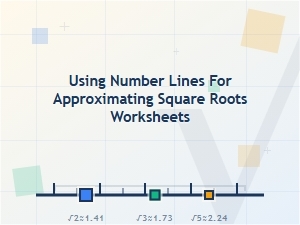 Using Number Lines for Square Root Approximation
 Estimate Square Roots with Geometry Practice Worksheets
 Square Root Approximation Practice Sheets with Whole Number Answers
 Estimating Roots with Perfect Square Anchor Charts
 Estimating Square Roots with Perfect Squares