You might think estimating a square root is just guessing a number close to the right answer. But square root estimation exercises with reasoning and justification turn that guess into a reliable skill. They train you to think step by step, check your work, and explain why your estimate makes sense. This matters because in real life whether you are measuring a garden, adjusting a recipe, or checking a calculator result you need to be confident your number is reasonable. Reasoning and justification help you catch mistakes before they cause trouble.
What does square root estimation with reasoning and justification actually mean?
It means you find a number that, when multiplied by itself, comes close to the original number. But you also explain how you got there. You might say, “I know 7 squared is 49 and 8 squared is 64, so the square root of 50 must be between 7 and 8. Since 50 is only one away from 49, I estimate 7.1.” The reasoning is the step-by-step thinking. The justification is the proof that your estimate is logical. This approach is different from just writing down 7.1 because it “feels right.”
When would you use these exercises?
You reach for square root estimation when you don’t have a calculator handy, or when you want to double-check a calculator result. It also shows up in math classes when teachers want to see if you understand the relationship between perfect squares and the numbers between them. Many students use these exercises when studying for tests, working on number line worksheets for approximating square roots, or getting ready for algebra. If you are learning how to simplify radicals later, this skill gives you a solid foundation.
How do you estimate a square root step by step?
Let’s walk through an example: estimate √75.
- Find the two perfect squares closest to 75. 8² = 64, 9² = 81. So √75 is between 8 and 9.
- Notice 75 is a bit closer to 81 than to 64. The difference from 75 to 81 is 6, and from 75 to 64 is 11. So √75 is probably near 8.7 or 8.8.
- Check 8.7² = 75.69, which is a little high. 8.6² = 73.96, a little low. So the best estimate is around 8.66 or 8.67.
- Justify: “I started with 8 and 9, then narrowed down using the distance to the perfect squares. I checked my guess by squaring it, and the result is very close to 75.”
This process is the heart of square root estimation exercises with reasoning and justification. You repeat it often until it becomes second nature.
Why do you need to justify your answer?
Justification proves you didn’t just copy a number. It shows you understand the logic. For example, if you estimate √50 as 7.07, you should be able to say, “7.07 squared is about 49.98, which is very close to 50. I know because 7² = 49 and 8² = 64, so the answer is near 7, and 7.07 is a common approximation.” Without that justification, the number is just a guess. Teachers, employers, and even your own self-checking depend on that reasoning.
What common mistakes should you avoid?
One big mistake is forgetting to check the square of your estimate. If you guess 8.5 for √75 without squaring it, you might not realize 8.5² = 72.25, which is too low. Another mistake is picking only one perfect square. You need both the lower and upper one. Also, some people try to use decimals that are too precise too early. Stick with tenths first, then refine. Finally, don’t skip the “why” part. If you can’t explain your reasoning, you haven’t truly estimated you guessed.
What are some useful tips for getting better at these exercises?
Memorize the perfect squares up to at least 12² (144). That gives you a frame. Use a number line in your head or on paper. Many learners find it helpful to work through square root approximation practice sheets with whole number answers to build confidence. Write down your thinking even simple notes like “between 5 and 6, closer to 5” help. When you check your answer, square it and compare. If the squared value is off by more than 0.5, adjust. The goal is not perfect accuracy the first time; it is consistent, logical improvement.
Also, take advantage of visual tools. A number line with tick marks at perfect squares makes the gap clear. You can also try the “nearest tenth” method: divide the difference from the lower perfect square by the total gap, then add that fraction to the lower square root. For √20: between 4 (16) and 5 (25). Gap is 9. Distance from 16 to 20 is 4. Fraction = 4/9 ≈ 0.44. So estimate ≈ 4.44. Check 4.44² = 19.71, close. This systematic approach is the kind of reasoning that sticks.
Where can you practice these exercises for free?
You already found a spot. The practice page I mentioned has free worksheets and an interactive calculator to test yourself. You can work through problems like √45, √110, or √150 and see if your reasoning matches the expected steps. Doing ten to fifteen problems a day, with written reasoning for each, will sharpen your estimation ability fast. Pair that with number line exercises to visualize every estimate.
If you want to make practice notes more readable, you can use a clean font like Roboto on your worksheets. It’s easy on the eyes and helps you focus on the numbers rather than the handwriting.
Practical next steps: a quick checklist
- Pick any number that is not a perfect square (start with numbers between 1 and 100).
- Write down the two perfect squares it falls between.
- Estimate a tenths‑place value.
- Square your estimate to check.
- Write one sentence explaining why your estimate is reasonable.
- Do this for three numbers each day for a week.
- Compare your estimates to the actual square root (using a calculator only after you have justified).
That routine turns estimation from a trick into a trustworthy skill. And every time you justify your thinking, you are building the kind of number sense that lasts beyond the next test.
Try It Free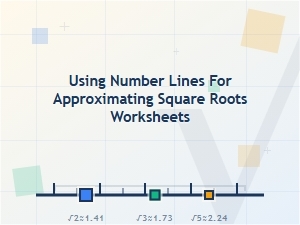 Using Number Lines for Square Root Approximation
 Estimate Square Roots with Geometry Practice Worksheets
 Estimating Square Roots Without a Calculator
 Square Root Approximation Practice Sheets with Whole Number Answers
 Estimating Roots with Perfect Square Anchor Charts
 Estimating Square Roots with Perfect Squares